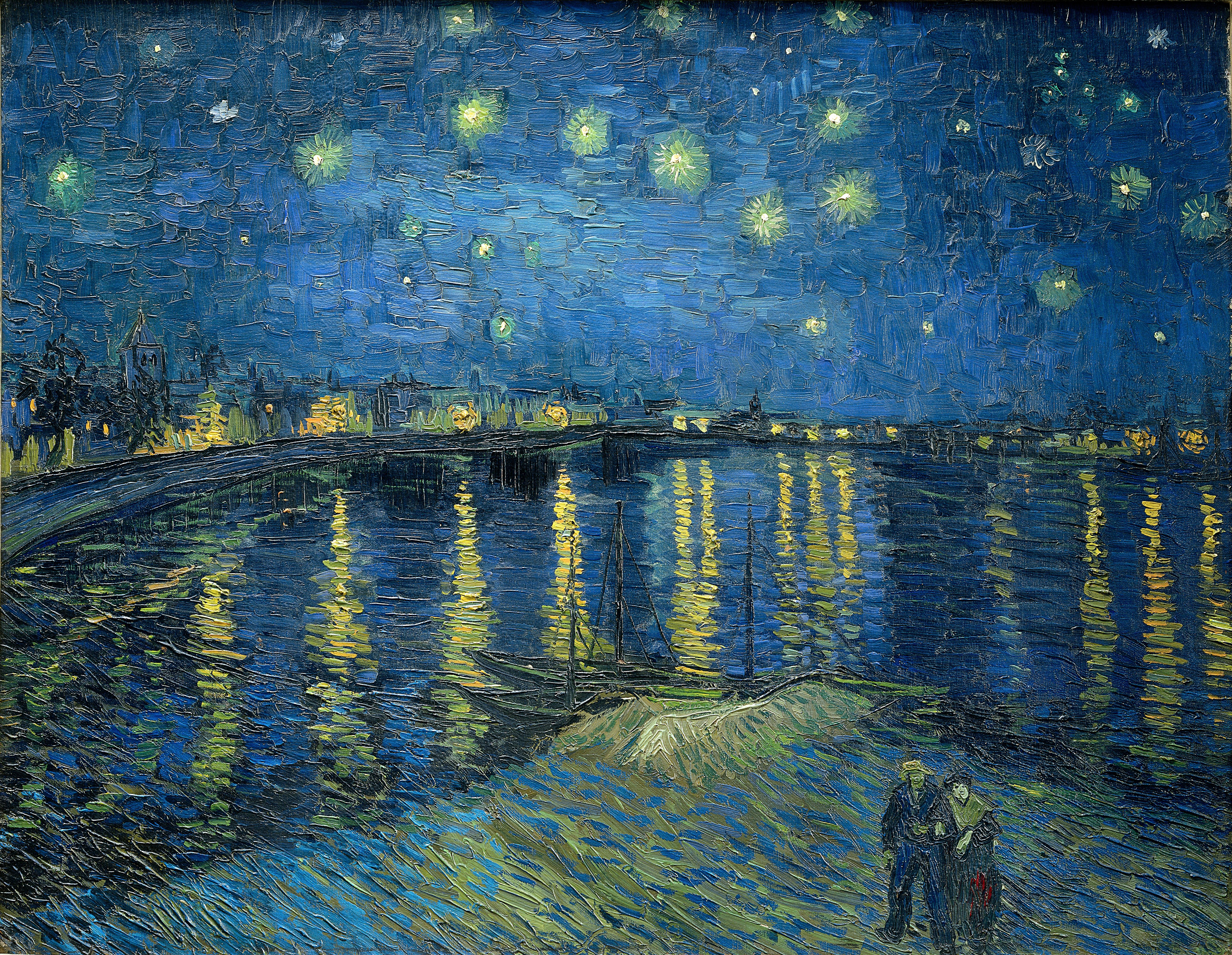
The night sky has been a reference point for human activity for millennia. Van Gogh, Starry Night Over the Rhône (1888). Public domain, Wikimedia Commons.
Meteor showers
Quadrantids — January 3–4
The Quadrantids peak in a narrow window (6–12 hours) around January 3–4, with a theoretical ZHR of 80–120 meteors per hour under ideal conditions. The radiant is in the constellation Boötes, circumpolar from Poland, meaning it is observable all night. In practice, the January weather across most of Poland — frequent cloud cover, low temperatures down to -15°C in the northeast — reduces the number of usable observation nights. Masuria and the Podlaskie highlands have statistically clearer January nights than western Poland.
Perseids — August 11–13
The most observed meteor shower in Poland due to summer temperatures and accessible dark-sky locations. The 2025 peak falls on the night of August 11–12. The Moon is a 10% waxing crescent setting before midnight, which is close to ideal: moonless skies after 22:00 during the best observing window. ZHR reaches 100+ at peak. The Bieszczady region — particularly the area around Wetlina, Cisna, and the Tarnica ridge — combines Bortle 3–4 skies with accessible accommodation and is a standard destination for Polish observers during the Perseids. No special equipment is needed; the Perseids are a naked-eye and binocular event.
Geminids — December 13–14
The Geminids produce the highest reliable ZHR of any annual shower (120–150), with the added advantage that the radiant in Gemini rises before midnight, allowing a full-night observation window. The 2025 peak coincides with a near-new Moon, which is a favourable configuration occurring roughly every few years. December temperature in Poland ranges from 0°C on the Baltic coast to -20°C in the Tatra region — layered clothing and a heated flask are not optional for a 4-hour session.
Planetary oppositions
Mars — January 16
Mars reaches opposition on January 16, 2025, at a distance of 0.64 AU — a relatively close approach but not as favourable as the 2018 opposition (0.38 AU). At opposition, the apparent diameter of Mars reaches approximately 14.6 arcseconds. This is sufficient to resolve the polar cap and major dark features (Syrtis Major, Hellas basin) in a 150 mm telescope under good seeing. Mars opposition repeats every 26 months, and the 2025 geometry places the planet in Gemini, at a declination of +25°, meaning it transits high in the sky from Poland — a significant advantage for seeing quality.
Jupiter — November 3
Jupiter reaches opposition on November 3, remaining observable through March 2026. At 45 arcseconds apparent diameter at peak, the cloud belts, Great Red Spot, and all four Galilean moons are visible in any aperture above 60 mm. A 150 mm telescope at 200× shows the equatorial belt structure clearly on a night with average seeing. Jupiter's Galilean moons — Io, Europa, Ganymede, Callisto — transit the disk and cast shadows in a repeating cycle documented in advance by Stellarium and other planetarium software.
Eclipses
Total lunar eclipse — March 14
A total lunar eclipse on March 14, 2025, is visible from Poland in its penumbral and early partial phases only — totality occurs while the Moon is below the Polish horizon (the event is timed for the Americas). The partial phase begins at 06:09 UT; sunrise in Warsaw is around 06:05 UT on that date, making this effectively a marginal event for observers in eastern Poland. Silesia and Pomerania, slightly further west, have a slightly earlier sunrise and a marginally better view of the partial phase in a brightening sky.
Partial solar eclipse — August 12
A partial solar eclipse crosses northern and central Europe on August 12, 2025. From Warsaw, approximately 35% of the solar disk is obscured at maximum at around 11:30 local time. From Szczecin and Gdańsk, coverage reaches 42–45%. Solar observation requires a certified solar filter (Baader AstroSolar film or glass equivalent) — standard sunglasses, CDs, and photographic film are not safe. The eclipse occurs in daylight, making it the most accessible major event of the year for casual observation.
Associations and events in Poland
Several organisations hold public star party events and maintain observatories open to members:
- PTMA (Polskie Towarzystwo Miłośników Astronomii) — the national body with chapters in Warsaw, Kraków, Wrocław, Poznań, Łódź, and Trójmiasto. Organises the annual Zlot Miłośników Astronomii (ZMA), held each summer at a dark-sky site, typically in Bieszczady or Suwałki regions.
- Obserwatorium Astronomiczne Uniwersytetu Jagiellońskiego (Kraków) — public observing nights on clear Fridays during the winter season. Advance booking required via the university website.
- Centrum Nauki Kopernik (Warsaw) — public planetarium shows and occasional rooftop observing sessions with club telescopes.
Page last reviewed: January 2025. Event times given in UT; add +1h for CET (winter) or +2h for CEST (summer).